Table Of Contents
- Name Change After Marriage
- Name Change After Divorce
- Correction of Spelling Mistakes
- Personal Preference
- Numerology and Astrology
- Religious or Cultural Reasons
- Gender Identity
- Adoption or Family-Related Changes
- Professional or Public Identity
- Adding, Removing, or Changing a Surname
- Frequently Asked Questions
- Final Takeaway
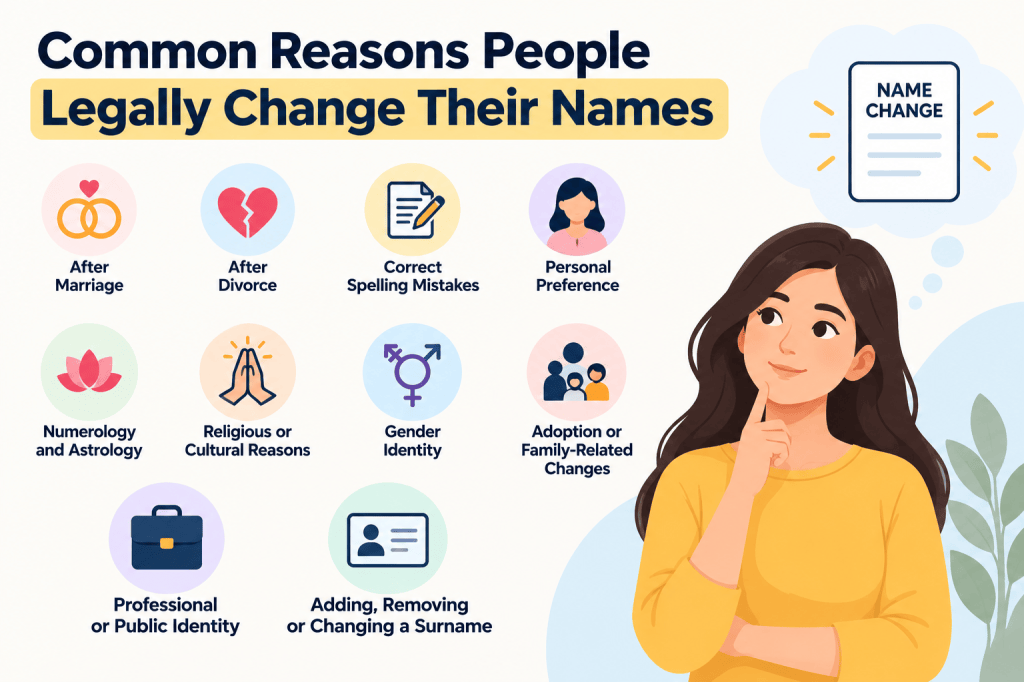
A person’s name is an important part of their identity. It appears on educational certificates, identity documents, bank accounts, passports, and other official records. However, people may choose to change their names for personal, family, cultural, or legal reasons.
In India, legal name change is a formal process that may involve an affidavit, newspaper publication, and Gazette notification, depending on the type of change and the requirements of the relevant authority.
Understanding the common reasons for changing a name can help individuals decide which procedure may apply to their situation.
1. Name Change After Marriage
One of the most common reasons for a name change is marriage. A person may choose to adopt their spouse’s surname, add it to their existing name, or use a different combination of names.
For example, someone named Priya Sharma may choose to use Priya Verma after marriage.
Changing a surname after marriage is a personal choice. The documents required to update official records depend on the institution and the type of name change.
2. Name Change After Divorce
After divorce, a person may want to return to their previous surname or adopt another name.
For example, someone who adopted their spouse’s surname after marriage may decide to use their maiden surname again.
Depending on the document being updated, the authority may ask for a divorce decree, affidavit, Gazette notification, or other supporting documents.
3. Correction of Spelling Mistakes
Spelling errors in names can occur in birth certificates, school records, identity documents, or other official paperwork.
For example, a name may be recorded as “Rahul” instead of “Raahul,” or a surname may contain a typing mistake.
Before applying for a complete legal name change, check whether the relevant authority permits a simple correction. Minor spelling corrections may follow a different procedure from a major name change.
4. Personal Preference
Some people change their names because they prefer a different name or want one that better reflects their personality.
A person may choose a shorter name, a modern name, or a name they have used informally for years.
If the person wants the new name to appear on official documents, they should check the applicable legal procedure, documentation requirements and cost.
5. Numerology and Astrology
In India, some people change the spelling of their names based on numerology or astrology.
For example, a person may add or remove a letter because they believe the new spelling will bring better opportunities or personal growth.
These are personal beliefs rather than guaranteed outcomes. Anyone planning such a change should also consider the effort involved in updating official records.
6. Religious or Cultural Reasons
A person may wish to adopt a name that reflects their religious beliefs, cultural background, heritage, or personal values.
The required process depends on the nature of the change. A change of name and a change of religion are not necessarily the same legal procedure.
Applicants should verify the applicable documentation requirements before submitting an application.
7. Gender Identity
Some transgender and gender-diverse individuals may choose a name that better reflects their gender identity.
A person may want their new name to appear consistently across identity documents, educational certificates, employment records, and other official paperwork.
The requirements may differ depending on the document and whether the application also involves a change of gender marker.
8. Adoption or Family-Related Changes
Following adoption or certain family-related changes, a child or adult may wish to adopt a different surname or update their name.
For minors, the application may need to be submitted by a parent or legal guardian, along with supporting documents.
The relevant authority may require adoption records, guardianship documents, consent, or other evidence depending on the circumstances.
9. Professional or Public Identity
Some individuals change their names to establish a distinct professional identity. This may apply to artists, writers, performers, entrepreneurs, or other professionals.
A person might choose a shorter, easier-to-pronounce name or one that is more suitable for their professional work.
However, using a professional or stage name is not always the same as legally changing the name on official records.
10. Adding, Removing, or Changing a Surname
A person may want to add a surname, remove an existing surname, restore a family name, or rearrange the parts of their name.
For example, someone whose documents contain only a first name may wish to add a surname for consistency across official records.
The appropriate process depends on the type of change and the requirements of the authority where the documents will be updated.
How to Legally Change Your Name in India
The process depends on the nature of the change and the relevant state or central authority. For many major name changes, the procedure may include:
- Prepare an affidavit: Declare your existing name, proposed new name, address, and reason for the change.
- Publish a newspaper notice: Complete newspaper publication if required under the applicable procedure.
- Apply for Gazette notification: Submit the prescribed application and supporting documents to the appropriate authority when required.
- Update official records: Use the accepted supporting documents to request changes to Aadhaar, PAN, passport, educational records, bank accounts, and other relevant documents.
The Department of Publication provides official guidelines for different categories of name changes, including adult and minor applicants, surname changes, and changes related to religion. Requirements can vary by category. <Cite refs={[“turn100389search0”]}/>
Frequently Asked Questions
Can I legally change my name for any reason?
A name change may be possible for various personal and legal reasons, subject to the applicable procedure, documentation, and restrictions.
Is a Gazette notification necessary for every name change?
Not always. Requirements depend on the type of change and the authority whose records need to be updated. Some minor corrections may follow a separate process.
Can I change my surname after marriage or divorce?
Yes, subject to the applicable documentation requirements. The documents needed may differ depending on the authority and the nature of the change.
How can I change my name on official documents?
First, determine which procedure applies to your situation. Complete the required formalities and then apply separately to each relevant authority to update its records.
Final Takeaway
People legally change their names for many reasons, including marriage, divorce, spelling corrections, personal preference, numerology, cultural identity, gender identity, and family-related changes.
Whatever the reason, it is important to understand the applicable procedure before beginning the process. Preparing the correct documents and checking the requirements of each authority can help reduce delays and inconsistencies across official records.
Disclaimer: This article is for general informational purposes only and does not constitute legal advice. Name-change procedures and documentation requirements may vary depending on the applicant’s circumstances and the relevant authority.


Leave a Reply